
Making Enemies
War and State Building in Burma
Häftad, Engelska, 2005
529 kr
Beställningsvara. Skickas inom 10-15 vardagar. Fri frakt för medlemmar vid köp för minst 249 kr.
Finns i fler format (1)
The Burmese army took political power in Burma in 1962 and has ruled the country ever since. The persistence of this government—even in the face of long-term nonviolent opposition led by activist Aung San Suu Kyi, who was awarded the Nobel Peace Prize in 1991—has puzzled scholars. In a book relevant to current debates about democratization, Mary P. Callahan seeks to explain the extraordinary durability of the Burmese military regime. In her view, the origins of army rule are to be found in the relationship between war and state formation.Burma's colonial past had seen a large imbalance between the military and civil sectors. That imbalance was accentuated soon after formal independence by one of the earliest and most persistent covert Cold War conflicts, involving CIA-funded Kuomintang incursions across the Burmese border into the People's Republic of China. Because this raised concerns in Rangoon about the possibility of a showdown with Communist China, the Burmese Army received even more autonomy and funding to protect the integrity of the new nation-state.The military transformed itself during the late 1940s and the 1950s from a group of anticolonial guerrilla bands into the professional force that seized power in 1962. The army edged out all other state and social institutions in the competition for national power. Making Enemies draws upon Callahan's interviews with former military officers and her archival work in Burmese libraries and halls of power. Callahan's unparalleled access allows her to correct existing explanations of Burmese authoritarianism and to supply new information about the coups of 1958 and 1962.
Produktinformation
- Utgivningsdatum2005-12-08
- Mått152 x 229 x 21 mm
- Vikt454 g
- FormatHäftad
- SpråkEngelska
- Antal sidor296
- FörlagCornell University Press
- ISBN9780801472671
- UtmärkelserWinner of the Harry J. Benda Prize (Southeast Asia
Tillhör följande kategorier
Hoppa över listan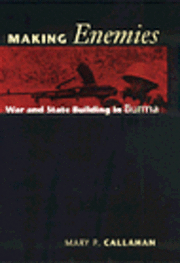









Du kanske också är intresserad av
- Nyhet
Del 11
- Nyhet
Del 3
- Nyhet
- Nyhet
- Nyhet
Del 6
- Nyhet
- Nyhet
Del 4
- Nyhet
Del 3
- Nyhet